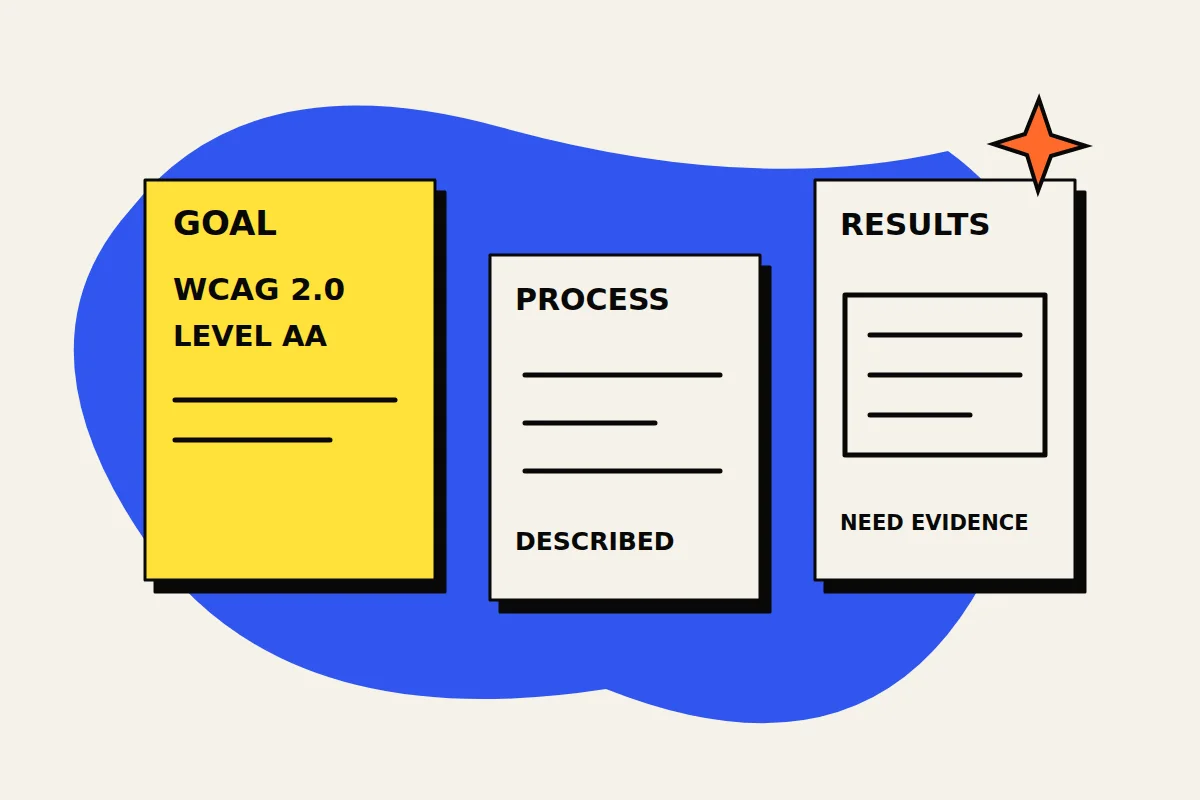
The former Box accessibility statement described a continuing process: testing, recording issues and making changes. Its wording did not establish that every page had passed an independent accessibility assessment. That distinction matters when an old badge or certification heading survives after the interface it described has disappeared.
This page explains the statement captured on September 22, 2020, which displayed an update date of October 16, 2019. It records the former service’s claims. The statement is not a certification of this independent journal or proof that the old assistive tools still operate here.
What the statement said was being checked
The text named internal resources and AudioEye as participants in monitoring and testing. It described automated and manual results being managed through AudioEye’s platform, with remediation tracked as issues and solutions were identified. Those are the published process claims; the retrieved page contains no test logs, list of tested URLs or results for individual controls.
For someone investigating the old rental interface, that missing detail is significant. A statement about a website-wide process does not reveal whether the gift-code field, a clothing filter or the cancellation flow worked with a particular assistive technology. The archive preserves the description of the programme, not the outcomes of those tasks.
A certification heading and a qualified claim
The certification section named WCAG 2.0 Level AA as its target. It said the site was in the process of being enhanced towards that target to the greatest extent possible.
The page’s own qualification matters more than the reassuring appearance of its certification heading. An enhancement process and an achieved result are different statements. No complete conformance result can be established from the wording and decorative seal alone.
What the Ally Toolbar was meant to offer
The statement described a free Ally Toolbar and listed tools that might be available: a player to read page content aloud, a reader to alter visual presentation, a voice control where applicable, simplified site and page-element menus, and an accessibility help desk. The conditional wording means the list is not proof that every tool was enabled on every page.
The captured text also includes an inactive-toolbar message and an activation control. That records what the source exposed; it does not demonstrate successful activation or a complete interaction. This reconstruction does not reproduce a button that pretends to launch the former tool.
The page listed browser and screen-reader combinations for Windows, Mac and mobile users. These belong to a statement labelled 2019 and captured in 2020. They are not current compatibility recommendations, and the archived list supplies no version-by-version test evidence.
Feedback was part of the stated process
The source invited visitors to report access barriers through its feedback and help-desk routes. It described specialists being available to assist, but supplied no case log or universal resolution deadline. An invitation to report a problem is not evidence that a particular report was answered or that the affected task was fixed.
Read this statement alongside the former account and support guide when tracing what the service said about access and assistance. For the broader collection, the help archive guide separates recovered explanations from controls that the journal does not operate. The surviving evidence supports a history of a stated accessibility effort; it does not support a retrospective guarantee that the whole service was accessible.