Before choosing a size, find out what the chart measures. A body-measurement chart describes the person a size is intended to fit. Finished garment measurements describe the clothes themselves. Comparing one with the other without noticing the difference can turn a careful-looking choice into a guess.
For a dress you need on a particular day, the useful question is more specific than “Am I usually a medium?” You want to know whether this cut, in this fabric, gives you the room and length you need for the way you will wear it.
Read the heading above the numbers
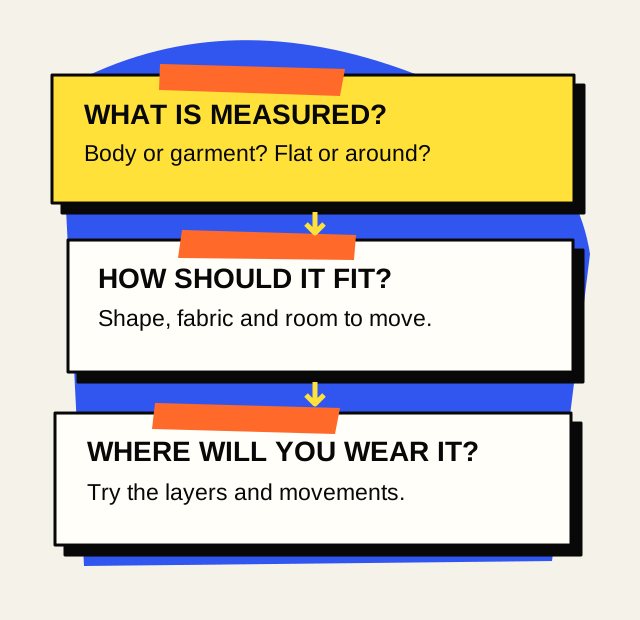
Look for the brand, garment type, units and measurement instructions. A general retailer chart and an item-specific measurement table may describe different things. Check whether a width was measured across a garment laid flat or all the way around it; those figures cannot be compared as though they were the same measurement.
Pattern maker Simplicity distinguishes body measurements from finished garment measurements and explains the difference as ease. Its charts are for sewing patterns, so their size numbers are not a conversion table for every ready-to-wear brand. The useful distinction is what each set of measurements represents.
Take a small set of measurements consistently
Use the measuring instructions that accompany the relevant chart. As a general starting point, measure over the undergarments you expect to wear, keep the tape level where the instructions require it and avoid pulling it tight enough to change the measurement.
- Bust: measure around the fullest part, keeping the tape straight across the back.
- Natural waist: locate the waistline rather than assuming it is where every pair of trousers sits.
- Hips: measure around the fullest part according to the chart’s method.
Write down the unit beside every figure. Measure again if the tape shifted or the result seems inconsistent. A useful note says what you measured and how; an unlabeled number saved on your phone is easy to misread later. For a fitted dress, also check whether the listing provides a relevant length, sleeve or other fit detail.
Understand what the extra room is doing
Imagine a fictional woven shirt with a finished chest measurement of 40 inches and a wearer with a 38-inch body measurement at the corresponding point. The difference is 2 inches. That calculation describes the two measurements; it does not establish that the shirt will feel comfortable or fit at the shoulders and arms.
In its guide to pattern size, Simplicity separates the body measurement from a finished size that includes wearing and design ease. A deliberately loose silhouette and a close-fitting design are trying to do different things. Do not remove all apparent extra room simply because the garment measurement is larger than your body measurement.
Equally, do not treat the same numerical difference as a universal rule for a knit top, a lined dress and a structured jacket. Check the item’s stated fabric behavior and intended fit. If that information is missing, record the uncertainty rather than filling it with a rule such as “always size down in this style.”
Compare with something you actually wear
A comfortable garment you own can be a useful second reference, provided you compare like with like. Choose a similar type of garment, lay it out as the seller’s instructions describe and use the same measurement points. A relaxed sweatshirt offers little evidence about how a tailored sleeveless dress will feel.
Note what you like about the reference piece: room to sit, a shoulder that stays in place, a hem that works with your shoes. This turns the comparison into a description of fit instead of a search for an identical size label. It also makes a question to a seller more useful: “Is this listed chest width measured flat?” is easier to answer than “Does it run small?”
Make the fitting a rehearsal
When the garment arrives, try the movements that matter before deciding to keep it. For a dinner outfit, sit down as well as stand in front of a mirror. For a jacket, check the reach you need while wearing the layer intended underneath. These are observations about this garment on you, not a rating of the size category.
Keep a short fit note with three parts: what worked, what did not and whether the problem changes your choice. “Waist comfortable; shoulders pull when I reach; not suitable for the planned day” says more than “medium too small.” It can also stop the next search from repeating the same mismatch. Check any applicable try-on and return conditions before removing tags or wearing an item beyond a fitting.
What the old size page can still tell us
The former Box service’s archived size page offered instructions for measuring the bust and natural waist. A separate support capture from April 2024 described its range as XS through L. Those are records of the former rental service, not today’s stock or a sizing promise from this journal. The recovered page does not provide a verified, complete numeric conversion table, so none has been invented here.
A useful fit decision brings together the chart’s meaning, your measurements, the particular garment and the way you will wear it. Once you have that note, place the outfit in a wardrobe rotation that fits your actual week, allowing for its care and drying requirements.