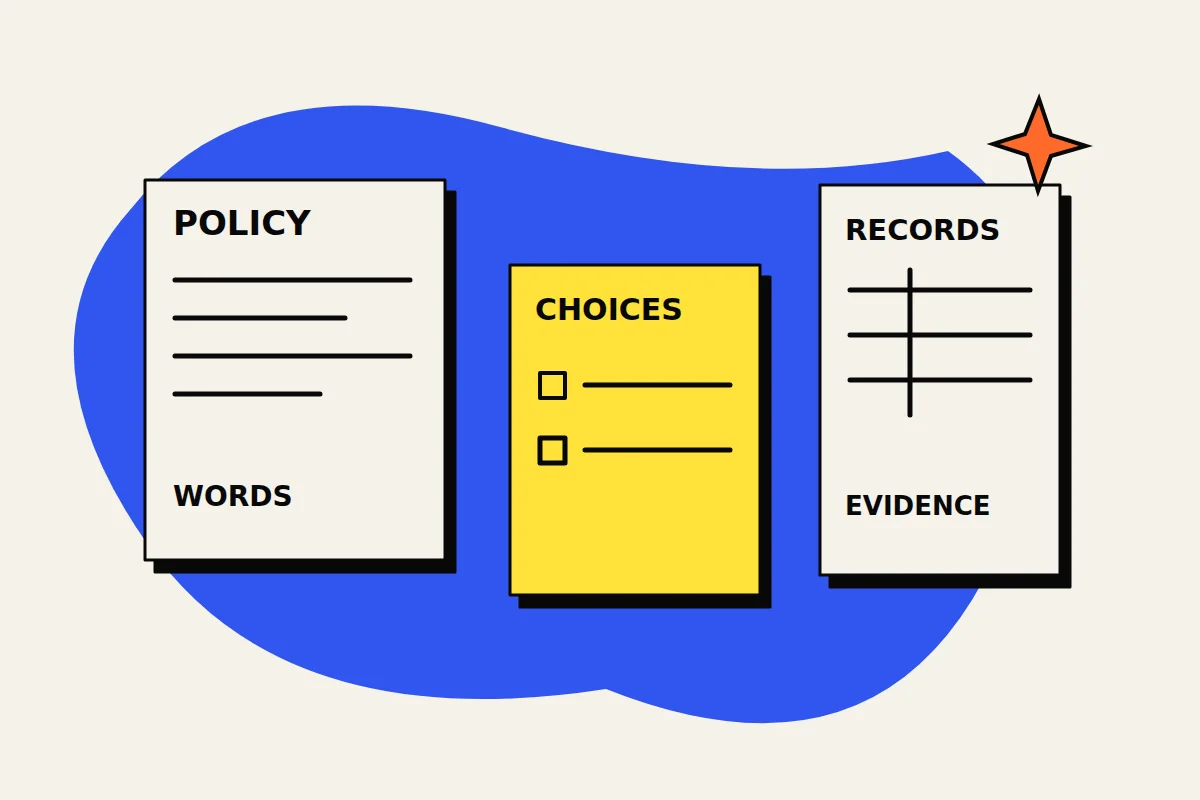
An old privacy notice can tell you what a clothing-rental business said it did with information. It cannot, by itself, show what happened to one person’s data. The former Box service left two useful records: a privacy policy marked November 21, 2019, and a separate California information-sharing disclosure captured in 2022. Reading them together reveals both the intended categories and several questions the archive cannot settle.
This is an independent historical reading of those documents. It is not the privacy policy for this journal, a live request form or a determination of anyone’s current legal rights.
Start with the document’s date and scope
The privacy policy captured on September 22, 2020 described the Stylist LA website and mobile app together as the service. Its displayed update date was November 21, 2019. Those dates answer different questions: one identifies the policy’s own label; the other records when that copy was archived. Neither establishes that every later account used the same terms.
The notice grouped information by how it arrived. It listed details supplied through accounts, contact requests and recruitment, information provided by third-party services, and automatically collected records. Names, contact details, passwords, resumes, public posts and messages appeared in its examples. That broad list covered more than clothing customers: a job applicant’s resume and a member’s delivery details served different purposes.
A payment processor was not the whole data picture
Section 3.1 named Stripe and Braintree as payment vendors and said the operator did not collect or store billing information. Elsewhere, the notice described collecting rental and purchase history. Outsourcing a card transaction therefore did not, in the document’s account, mean there was no record of what a member rented or bought.
Consider a hypothetical member who bought a jacket after renting it. The payment details, the garment’s purchase history and messages about the order would be different kinds of information. This example explains the document’s categories; it is not evidence of a transaction or a verified map of the former database.
The policy also said information could be used to run and personalise the service, send communications, provide advertising, authenticate access, support recruitment and protect the service. It described disclosures to providers and business partners, transfers connected with changes of control, and disclosures for stated legal or security purposes. Its retention clause tied keeping information to those purposes and applicable law; it gave no single retention period in days or years.
The advertising passages need to stay together
The cookie section distinguished required, performance, functionality and advertising categories. It described account-related cookies, remembered preferences, retargeted advertising, web beacons and Google Analytics. Its examples included measuring interactions with marketing emails as well as activity on the website.
Later, section 11 stated that the operator did not track site users over time and across third-party websites for targeted advertising, and said it did not respond to browser Do Not Track signals. That statement sits uneasily beside the earlier description of advertising partners collecting activity across sites. The passages have different subjects and may have been intended to describe different practices, but the archived text does not fully reconcile them. It would be misleading to reduce this notice to an unconditional claim that no tracking occurred.
Old links and browser instructions in a policy are also historical content. Their presence does not establish that an opt-out tool remains available or works with the present website.
The California table was broader than a customer profile
The separate disclosure captured on July 1, 2022 organised information into categories and named recipient groups. It explicitly warned that the comprehensive list included contexts other than the reader’s own. Its example distinguished employee information from information about clothing customers. A category appearing in the table is therefore not evidence that the business collected every example from every member.
The business-purpose table covered identifiers, customer-record categories, protected characteristics, commercial records, online activity, geolocation, employment information, non-public education information and inferences. Recipient groups varied by row. For example, identifiers and commercial records included advertising networks and joint marketing partners, while the employment and education rows listed affiliates, business partners, government entities where needed and service providers.
A second table described transfers for valuable consideration during the preceding twelve months. It listed advertising networks against five categories: identifiers, the broad customer-record category, commercial information, online activity and geolocation. The phrase preceding twelve months belongs to that disclosure; the archive capture alone does not establish the exact dates of the underlying transfers.
This later table should not be silently collapsed into the older policy’s billing paragraph or its opening statement about not selling, leasing or renting data unless otherwise disclosed. The documents differ in date, scope and terminology. They record published positions, not an independently audited transaction history, and the retrieved copies do not establish which wording governed a particular person’s information.
A request channel did not promise deletion of everything
The older policy described access to, editing of and deletion of certain categories through an account, alongside an email or postal request route. It separately described opting out of promotional email while retaining transactional and operational messages. Stopping marketing email was therefore not described as ending membership, erasing all records or suppressing a password-reset message.
The document also discussed security measures without guaranteeing absolute security and stated that the service was not intended for children under 18. The former general terms used different wording about supervised use by teenagers. That difference remains a source limitation, not a basis for inventing a unified age policy.
For the old account controls, read the account and support reconstruction. For the surrounding document relationships, see the guide to the former service agreements. The useful distinction is between a policy’s statement, an available control and evidence that a request was actually fulfilled. These sources preserve the first and describe some of the second; they do not prove the third.