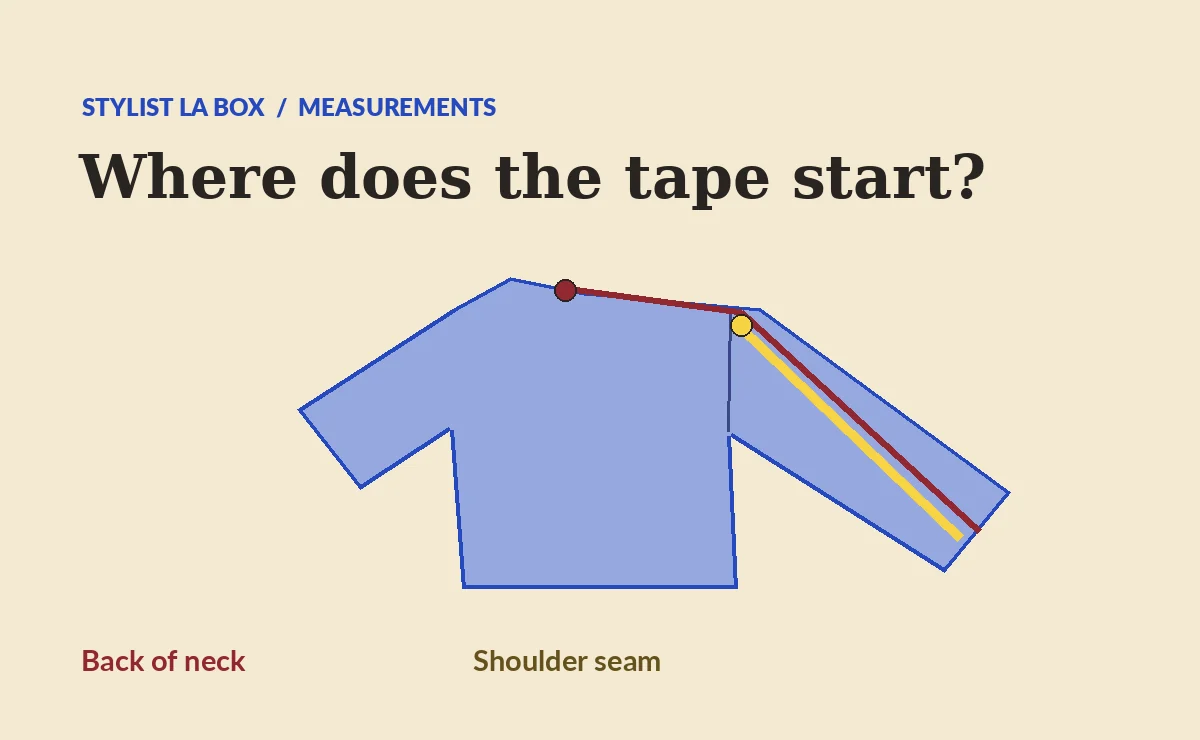
Before you compare sleeve lengths, draw a little mark at the starting point. A number taken from the back of the neck and a number taken from the shoulder seam describe different paths. Both can be useful when the path is written beside the measurement.
Two routes to the cuff
A body-size chart may tell you to measure from the centre of the back of the neck, over the shoulder and down the arm. For example, L.L.Bean uses that route in its men’s size guide and describes the arm as relaxed and slightly bent. That is the maker’s method for the cited chart. Check the instructions with the particular garment you are considering. L.L.Bean size chart.
A second-hand listing may show the length of a sleeve laid flat, with the tape running from the shoulder seam to the cuff. That can be a useful comparison with a jacket you own. Set the two garments down in the same position and make sure both measurements start at a comparable seam.
Make the comparison with a garment you already reach for
Suppose the seller gives 61 cm from shoulder seam to cuff. Your favourite jacket measures 59 cm along the same route. The extra two centimetres are easier to picture if you mark them on the jacket you know. Then look at the seller’s shoulder width. A dropped seam starts farther down the arm and can change where the cuff lands even with a shorter seam-to-cuff number.
Set-in shoulders, dropped shoulders and raglan seams give the tape different starting places. If the listing has a raglan sleeve and your comparison is a narrow set-in jacket, ask for a second measurement or a photo showing the tape. A measurement from the neck along the top of the sleeve is another option when both sides agree exactly where the tape starts.
Write the measurement so someone else can repeat it
For a listing or a message to a seller, put the route, the unit and the position together: “61 cm, measured flat from the top shoulder seam to the outside edge of the cuff.” If the cuff is elasticated, mention whether it was measured relaxed. For a coat, try the comparison layer over the clothes you normally wear underneath it.
Once you have a comparable measurement, think about where you want the sleeve to finish. A little extra room can work over a knit. A cuff you keep pushing back while typing tells you something different about how you wear the garment. Keep that practical detail next to the number.